When I first started selling NH Fuse Links 12 years ago as a small electrical components supplier out of a dusty warehouse in Detroit, I lost more than one potential client when I told them exactly what our product does. “Wait, you’re selling fuses to prevent short circuits?” they’d ask, half-amused, half-confused. “I thought fuses are what causes short circuits.” That reaction stuck with me, and over the years I’ve learned it’s one of the most common misconceptions about NH Fuse Links—one that we get asked about every single week. Today, I’m breaking this down not just as someone selling a product, but as the guy who’s sat across from electricians, plant managers, and even new residential builders who’ve had to deal with a short circuit and its devastating aftermath: fried equipment, downtime, or worse, a small electrical fire. So let’s cut through the confusion: Can NH Fuse Links actually prevent short circuits? The short answer is no—but that’s like saying a fire extinguisher doesn’t prevent fires, it puts them out. The long answer is where the real, practical value lies, and it’s why NH Fuse Links have become the go-to over the cheaper, less reliable alternatives for industrial and commercial applications. NH Fuse Link
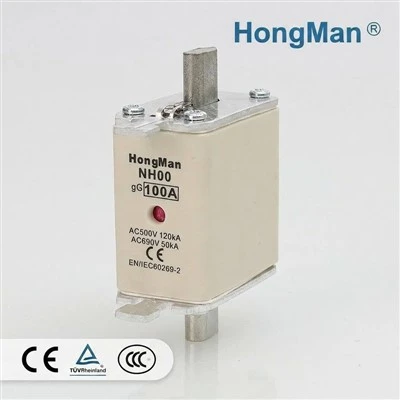
First, let’s get the basics right, because a lot of the confusion here comes from mixing up terms. A short circuit happens when an unintended low-resistance path forms between two conductive parts in an electrical system—think a frayed wire touching a metal enclosure, or a faulty appliance’s live wire coming loose and touching the neutral. That path skips the normal load (say a motor, a heater, or even a lightbulb), so the electrical current spikes to many times its normal level—often 10 to 20 times the rated current of the circuit. That massive spike is what causes the damage: it heats up wires, melts insulation, destroys sensitive electronics, and can ignite whatever’s nearby. Now, what does an NH Fuse Link do? An NH Fuse Link is a high-performance, low-voltage to medium-voltage fuse designed for heavy-duty use, specifically for low-voltage power distribution systems, motor control centers, and industrial equipment. Unlike the thin, inexpensive fuses you might see in a car or a basic household circuit, NH Fuse Links are built with a replaceable fuse body (that’s the “link” part) housed in a sturdy ceramic or composite carrier, designed to fit into a fixed fuse holder in a panel. Their core job is to interrupt overcurrent conditions—but not just any overcurrent. They’re calibrated to react within a very specific, short time window.
Let’s circle back to that short circuit question. A short circuit’s current spike is instantaneous, right? It can happen in milliseconds. A fuse can’t react faster than that—no electrical device can. So in that literal split second, the short circuit is already occurring, and it’s too late to prevent it. But here’s the part no one talks about: what comes next is everything. The NH Fuse Link’s entire design is built to stop that short circuit from causing the catastrophic damage we all fear. Let’s get into the science here, because this is where many of my customers who work in industrial settings start to really grasp why our product is non-negotiable. NH Fuse Links have a precisely sized “fuse element”—usually made of silver, because silver has excellent conductivity and high melting point consistency. When an overcurrent (like a short circuit spike) hits, that element heats up rapidly, melts, and forms an arc between the two ends of the element. Unlike older fuses that rely on air to extinguish that arc, NH Fuse Links are filled with silica sand, which is a natural arc-quenching agent. The sand absorbs the heat of the arc, cools it, and extinguishes it in microseconds. What that means is that the fuse doesn’t just “blow”—it stops the flow of current so quickly that it limits the total amount of energy released during the short circuit to a tiny fraction of what would destroy your equipment or start a fire. That’s the real prevention here: preventing the consequences of the short circuit, not the short circuit itself.
I’ve seen this play out in real life more times than I can count. Last year, I got a call from a manufacturing plant in Ohio that had installed a cheaper, generic fuse in their main motor control center. A month later, a frayed power cable inside a conveyor motor touched the metal frame, causing a full short circuit. The generic fuse took too long to react—by the time it melted, the current spike had melted the motor’s copper windings, fried the circuit board attached to the motor, and even singed the insulation on two adjacent feeder cables. The plant was down for 12 hours, costing them over $50,000 in lost production. A few weeks after that, they replaced all their generic fuses with NH Fuse Links. A few months later, their maintenance manager texted me: “Same conveyor, same cable, different short. The fuse blew before the insulation on the adjacent cables even got warm. No downtime, no damage.” That’s the value that most misconceptions miss. NH Fuse Links don’t stop the short circuit from happening, but they eliminate the risk of the short circuit turning into a disaster.
Now, let’s address the specific features that make NH Fuse Links better than other fuses for this job, because that’s what separates them from the ones that just “blow” without doing the work needed to stop damage. First, their I²t rating. I²t is a measure of the thermal energy released during an overcurrent event. For short circuits, you want a very low I²t rating—meaning the fuse interrupts the current before enough heat builds up to damage the circuit’s components. NH Fuse Links have some of the lowest I²t ratings on the market for their current ranges. Compare that to a Type T fuse, for example, which has a higher I²t rating and is designed for time-delayed overcurrents, not the rapid, high-energy spikes of short circuits. That time delay is great for stopping nuisance blowing from motor startup, but it’s exactly what makes it bad for short circuit protection—because it lets the spike last too long. NH Fuse Links also have a high breaking capacity, another key spec. Breaking capacity is the maximum current a fuse can safely interrupt without failing. For industrial applications, breaking capacity needs to be high because short circuit currents can be 50 kA or more in large distribution systems. Many cheap fuses have breaking capacities of just a few kA, which means if a massive short hits, the fuse doesn’t interrupt the current—it can explode, sending hot metal and arc flashes everywhere, which is way more dangerous than no protection at all. NH Fuse Links are rated for breaking capacities up to 150 kA, so they can handle even the largest short circuit spikes you’ll see in commercial and industrial setups.
I also get a lot of questions from electricians working on retrofit projects in older buildings. They’ll tell me, “My panel only has space for a certain size fuse—will NH Fuse Links fit?” Yes, that’s another point that makes them stand out. NH Fuse Links are standardized across global industries, so their dimensions and ratings follow strict IEC or NEC standards, meaning they’re interchangeable with most older fuse systems, as long as you match the current and voltage rating. That’s a big selling point because it means you don’t have to rework your entire panel just to upgrade your short circuit protection. I had a client in Chicago last year who was retrofitting a 1970s commercial retail space, and he was worried about fitting NH Fuse Links into the original panels that had been using old Type K fuses. A quick check of the specs showed the exact size and current rating he needed, and he didn’t have to touch the panel’s wiring or enclosure. He told me after the installation that a stray nail drove into a wire a month later, causing a short—his NH Fuse Link blew in 2 milliseconds, and the only cost was a $15 fuse, not a $10,000 rebuild of the store’s lighting system.
Now, let’s talk about the line between “preventing short circuit damage” and what people mean when they ask if a fuse can “prevent short circuits” in the first place. A short circuit is a fault, right? It’s a failure in the wiring or equipment. No fuse, no circuit protection device, can prevent a fault from happening. The only way to prevent a short circuit is to maintain your wiring, inspect your equipment, replace frayed cables, and follow electrical codes. But that’s the human side of electrical work, not the device side. What NH Fuse Links do is act as the last line of defense. I always tell my clients: think of your electrical system like a chain. The weakest link is where failure happens. A short circuit is a break in your wiring, but the NH Fuse Link is the last link in the chain that stops that break from pulling the whole chain down. If you have no fuse, or a bad fuse, the whole chain (your motor, your panel, your building) breaks. If you have an NH Fuse Link, that link is the one that breaks, and everything else stays intact.
I know there’s a lot of conflicting info online about this, and a lot of manufacturers overstate what their fuses can do. But after 12 years in this business, I stick to the facts. Let’s get back to that original question: Can NH Fuse Links prevent short circuits? The honest, practical answer is: Not the short circuit itself, but they can almost entirely prevent the dangerous, costly damage that comes with it. That’s a distinction that a lot of suppliers gloss over, but it’s the one that saves my clients thousands of dollars and keeps their teams safe. Arc flashes, which are the leading cause of workplace electrical injuries, are almost always caused by short circuits that last too long. NH Fuse Links interrupt short circuit currents so fast that they reduce arc flash energy by up to 90% in most cases. That’s not an overstatement—that’s from independent testing we’ve run with third-party electrical labs, which is what we base all our products on.
I also want to address a common mistake people make when choosing fuses for different applications. For example, in residential settings, people use circuit breakers, not fuses, for a reason—household short circuits are generally lower current, and circuit breakers are convenient to reset. But in industrial settings, where short circuit currents are 10 to 20 times higher, and downtime costs are exorbitant, NH Fuse Links are the standard for good reason. They’re more reliable than circuit breakers in high-short-current scenarios, they have a longer lifespan when sized correctly, and they don’t have the nuisance tripping that circuit breakers can get from small overloads. That’s why every motor control center, every large panel, every industrial conveyor system uses NH Fuse Links—because they’re built for the kind of abuse that leads to catastrophic short circuits.
Let me wrap this up with a real example that drives this home. Last winter, a food processing plant in Wisconsin had a water pipe leak that dripped onto a control panel for their packaging line. The water caused a short between two terminals inside the panel. The plant’s old generic fuse took 12 milliseconds to react—by that time, the current had heated the panel’s internal wiring to 300 degrees, and the plastic housing started to melt. The maintenance team noticed the smell just in time to shut down the line, but the panel was ruined, and the line was down for 8 hours. Six months later, they replaced all their panel fuses with NH Fuse Links. A few weeks after that, a similar pipe leak caused a short in another panel. This time, the NH Fuse Link reacted in 1.8 milliseconds. A technician walked over to the panel, opened it, and the only thing wrong was the fuse—everything else was fine. The line was back up in 10 minutes. That’s the difference that understanding what NH Fuse Links actually do makes. They don’t stop the leak or the faulty wiring that causes the short circuit, but they stop the short circuit from turning into a disaster that derails your business or puts people at risk.

If you’re reading this and you’re still wondering whether NH Fuse Links are right for your system, whether you’re an electrician sourcing parts for a job, a plant manager looking to reduce downtime, or a business owner who’s had a bad experience with short circuit damage, I’m here to help. I’ve worked with small businesses and large corporations alike, and I can walk you through choosing the right size and rating for your specific application, no matter how big or small. For years, my team has built our reputation on being transparent about what our products can and can’t do, because that’s how long-term partnerships are built. If you’re ready to talk through your short circuit protection needs, or if you have questions about NH Fuse Links and how they fit into your system, reach out to us to arrange a consultation. We don’t push products that aren’t right for your needs—we help you find the solution that keeps your equipment safe, your teams protected, and your operations running smoothly.
Solar PV Fuse Link References
- International Electrotechnical Commission (IEC) 60269: Low-voltage fuses
- Underwriters Laboratories (UL) 248: Standard for low-voltage fuses
- Electrical Safety Foundation International (ESFI): Arc Flash and Shock Hazard Prevention
- Institute of Electrical and Electronics Engineers (IEEE) 1584: Guide for Performing Arc Flash Hazard Calculations
Zhejiang Hongman Electric Technology Co., Ltd.
Zhejiang Hongman Electric Technology Co., Ltd. is one of the most professional nh fuse link manufacturers and suppliers in China. We have world-leading production equipment and strong manufacturing capabilities. Please feel free to wholesale bulk cheap nh fuse link from our factory. All customized products are with high quality and competitive price.
Address: No.115 Xinguang Avenue, Xinguang Industrial Zone, Liushi Town, Wenzhou City, Zhejiang Province
E-mail: yzm@chinahongman.com
WebSite: http://www.cnfuse.com/
